7 Proven Ways to Make Your Shopify Store AI-Friendly with LLM SEO
The ecommerce world is evolving faster than ever—and AI is leading the way. These days, your shoppers don’t just “Google” what they want; they’re asking AI assistants for personalized recommendations, product comparisons, and suggestions tailored just for them. If your Shopify store isn’t optimized for AI, you could be missing out on millions of potential buyers.
This is where Large Language Models (LLMs) come in—the brains behind ChatGPT, Google Gemini, and Copilot. They can read, understand, and recommend your products, giving your store enhanced visibility beyond traditional search engines.
In this guide, we’ll show you 7 proven ways to make your Shopify store AI-friendly using LLM SEO, explain how llms.txt can help your store get noticed, and share how Emerge Digital can help your brand get discovered by AI—not just Google—while improving your Shopify development and ecommerce SEO.
Table of Contents
- What Are Large Language Models (LLMs)?
- Why LLMs Matter for Ecommerce and Shopify Stores
- How Large Language Models Work (Simplified)
- How to Use LLMs for Your Shopify Store
- 7 Practical Ways to Optimize Your Shopify Store for LLM SEO
- Best LLM SEO Tools for AI-Optimized Shopify Stores
- The Role of llms.txt in AI Search Discovery
- Make Your Shopify Store AI-Ready with Emerge Digital
- Final Thoughts: Get Discovered by AI, Not Just Google

What Are Large Language Models (LLMs)?
If you’ve ever asked ChatGPT, Google Gemini, or Copilot for product suggestions, you’ve already interacted with a Large Language Model (LLM).
LLMs are advanced AI systems trained on billions of words from the web. They understand context, intent, and language patterns — generating human-like text in response.
In simple terms, LLMs are the brains behind modern AI assistants. They can read, summarize, and recommend products, making them the next big discovery platform for ecommerce businesses.
If SEO once helped your store get found on Google, LLM optimization will help you get discovered inside AI-powered search experiences.
Why LLMs Matter for Ecommerce and Shopify Stores
These days, buyers aren’t just “Googling” products—they’re asking AI assistants:
- “What’s the best organic skincare brand for dry skin?”
- “Can you recommend a Shopify store that sells eco-friendly office supplies?”
Chances are, the answers they get are coming from LLMs, not traditional search engines. For your Shopify development and ecommerce SEO, this shift is a big deal. Here’s why it matters for your store:
AI Assistants Act as Your Shopping Advisors
LLMs can summarize reviews, compare features, and suggest where to buy—helping your Shopify store stand out and get noticed by the right shoppers.
Structured, Conversational Content Wins
When your pages are clear, well-labeled, and optimized for Shopify development and ecommerce SEO, AI is more likely to recommend your products in responses.
Early-Mover Advantage
Right now, very few Shopify stores are optimized for LLMs. By acting now, you can lead the way in AI discoverability, smart Shopify development, and modern ecommerce SEO—getting ahead of your competition.
How Large Language Models Work (Simplified)
Think of LLMs as predictive text on steroids. They don’t “search” the web in real time. Instead, they generate recommendations based on the massive data they’ve already learned.
Example:
When someone asks, “What’s the best gift for a coffee lover?” — the LLM recalls relevant knowledge and recommends products or ideas it has seen before.
What this means for your Shopify store:
To get recommended by AI, your content needs to clearly show what you sell, who your customers are, and why your products stand out. Proper Shopify development and smart ecommerce SEO make sure LLMs understand your offerings, so your products can be confidently recommended to potential buyers.
How to Use LLMs for Your Shopify Store
Think of LLMs as your 24/7 content assistants for Shopify development and ecommerce SEO. When used effectively, they can boost your store’s visibility, improve conversions, and make the shopping experience smoother for your customers. Here’s how you can leverage them:
- Product Descriptions
Create engaging, benefit-driven copy that turns visitors into buyers. Well-crafted product descriptions, optimized for ecommerce SEO, help LLMs understand exactly what you sell and make your products more discoverable in AI-powered recommendations. - Email & Ad Copy
Generate multiple variations of product-focused emails, social media posts, and ad headlines in seconds. Optimized messaging keeps your branding consistent, aligns with Shopify development best practices, and makes your store AI-ready. - Customer Service & AI Chatbots
Deploy AI-powered chatbots for FAQs, returns, or personalized product suggestions. By integrating them into your Shopify store, you improve user experience, strengthen ecommerce SEO, and boost customer retention. - Keyword Research & SEO Optimization
Use LLMs to discover conversational, long-tail keywords that your real customers use. Incorporate these insights into product pages, blogs, and landing pages to enhance your Shopify development strategy and increase visibility in both AI-driven and traditional search results. - Content Strategy Beyond Writing
The key isn’t just generating text—it’s about making sure your store communicates effectively with both humans and AI. Structured data, FAQs, and well-organized blog content all support ecommerce SEO, making your Shopify store more authoritative, discoverable, and ready for AI-powered shopping assistants.
The secret: Don’t just use AI to write content—use it to optimize how your store communicates, helping both shoppers and AI understand your products better.

7 Practical Ways to Optimize Your Shopify Store for LLM SEO
Optimizing your Shopify store for AI-powered discovery is key to staying ahead in ecommerce. These seven proven strategies integrate Shopify development best practices with ecommerce SEO to make your store LLM-friendly:
- Write Conversational, FAQ-Style Content
LLMs love question-based content. Add FAQs to every product page:
- “What size should I buy for the Classic Linen Shirt?”
- “Is this suitable for sensitive skin?”
- “Can I return this if it doesn’t fit?”
Use H3 or H4 headings for each question and include high-intent keywords, e.g., “Best [product name] for [specific use case].” This not only improves AI discoverability but also boosts ecommerce SEO and conversion rates for your Shopify development store.
- Add Structured Data (Schema Markup)
Structured data helps Google and LLMs understand your Shopify pages. Add schema for:
- Products (price, SKU, reviews, availability)
- FAQs
- Reviews
- Breadcrumbs
Use Shopify apps like JSON-LD for SEO or Schema Plus. Test using Google Rich Results Test. Structured data enhances ecommerce SEO while making your Shopify store AI-ready.
- Create Value-Driven Product Descriptions
Avoid short, generic, or keyword-stuffed copy. Instead:
- Start with a hook
- Highlight features, specs, and use cases
- Add a real-world example or customer quote
Use long-tail keywords like: “How to choose [product] for [specific need].” Well-crafted product descriptions boost Shopify development quality, improve ecommerce SEO, and help LLMs recommend your products.
- Leverage User-Generated Content and Reviews
Authentic reviews build trust with AI and human shoppers alike. Encourage customers to:
- Share photos or videos using your product
- Mention specific benefits or use cases
- Leave detailed feedback
Add review schema and make reviews crawlable. This strengthens your ecommerce SEO, increases LLM visibility, and drives higher engagement in your Shopify development store.
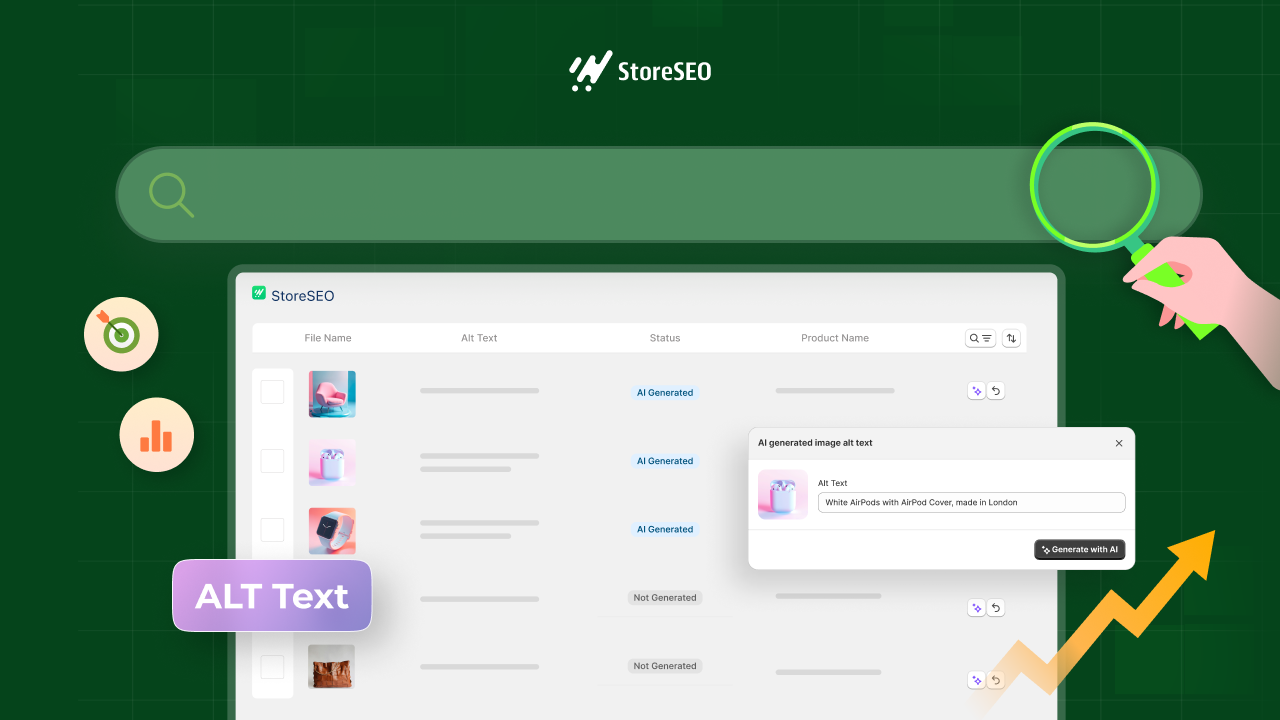
- Optimize Images for AI Discovery
Alt text helps AI “see” your products. Write descriptive alt text:
- “Eco-friendly bamboo water bottle for office and outdoor use”
Include material, context, and audience. Compress images, use WebP, and clean filenames like bamboo-water-bottle-eco-shopify.webp. Image optimization improves page speed, ecommerce SEO, and AI-driven product recommendations.
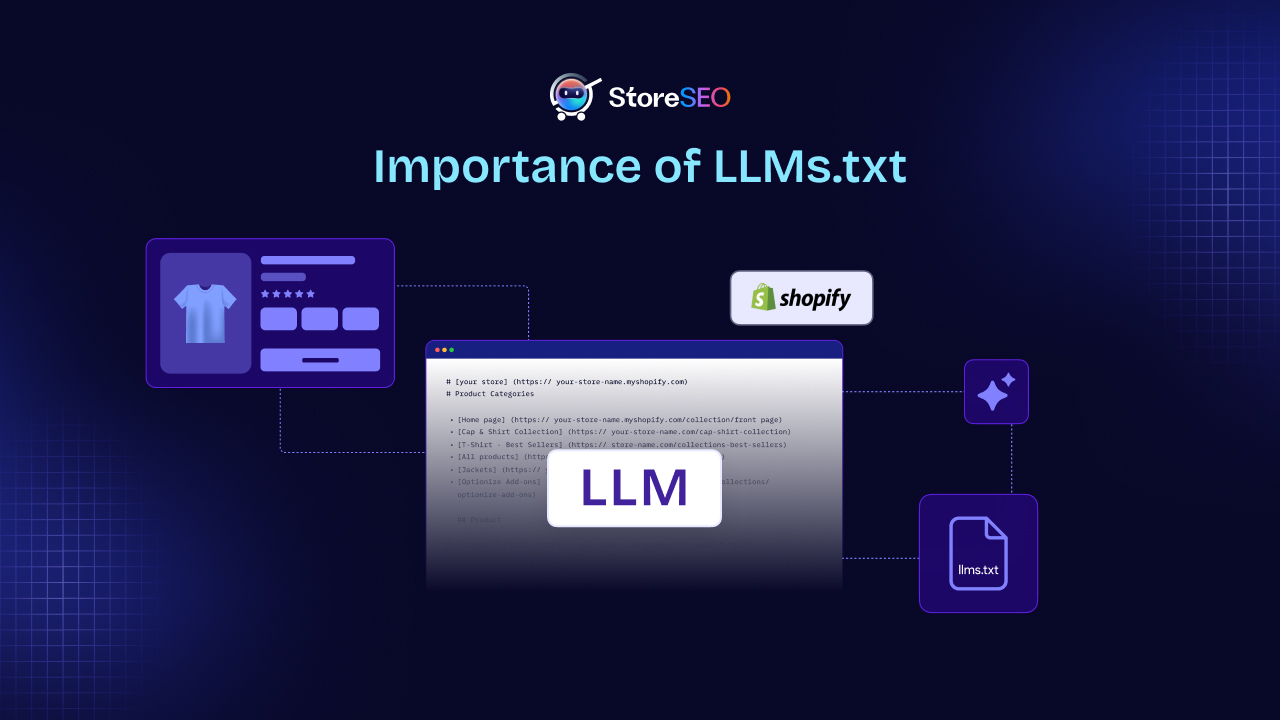
- Create an llms.txt File
Like robots.txt, llms.txt guides AI on which pages to learn from. Steps:
- Create llms.txt in plain text
- Add important URLs: product pages, FAQs, blogs, policies
- Upload to your root directory: yourstore.com/llms.txt
Example entries:
/products/eco-friendly-laptop-bag
/blog/best-sustainable-office-accessories
/pages/shipping-and-returns
Focus on clear, factual content with buyer intent. This enhances AI recommendations and aligns with Shopify development and ecommerce SEO best practices.
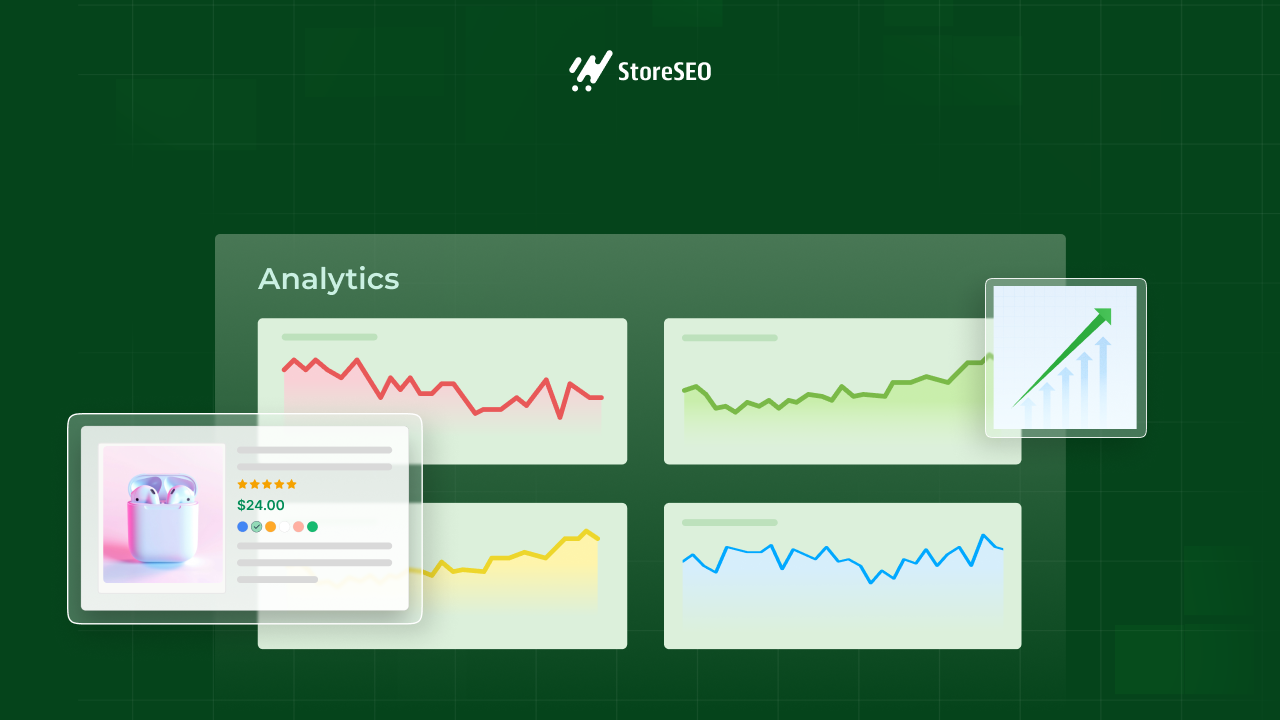
- Monitor, Measure, and Iterate
LLM SEO is an ongoing process. Track:
- FAQ-rich results in Search Console
- Top landing pages via Shopify Analytics
- AI referral traffic (UTM tags or analytics tools)
Regularly update FAQs, product descriptions, and llms.txt to reflect trends and customer questions. Continuous monitoring ensures your Shopify store development stays optimized for AI discoverability, faster conversions, and superior ecommerce SEO performance.
Best LLM SEO Tools for AI-Optimized Shopify Stores
Optimizing your Shopify store for AI-powered discovery is easier when you leverage the right LLM SEO tools. These platforms help Shopify development teams and ecommerce marketers create, optimize, and measure content for AI recommendations while boosting ecommerce SEO performance:
- Surfer SEO
Ideal for content optimization and NLP analysis. Surfer SEO’s real-time editor helps align product pages and blog content with LLM factors, improving AI visibility and supporting Shopify development efforts. - Clearscope
Generates AI-powered content briefs that guide product pages and ecommerce blogs. Clearscope ensures your Shopify content is structured, relevant, and optimized for both LLM SEO and ecommerce search visibility. - MarketMuse
Focused on topic strategy and authority building. MarketMuse uses content clustering to help LLMs recognize your Shopify store as an expert in your niche, enhancing ecommerce SEO and product discoverability. - Jasper + Surfer
Combines AI content generation with optimization tools. This integration allows Shopify developers and marketers to efficiently create LLM-friendly copy that drives engagement and conversions. - Scalenut
An all-in-one platform that converts keywords into full content quickly. Scalenut helps you generate AI-ready Shopify pages in minutes, boosting ecommerce SEO and product visibility. - Frase
Specializes in AI overview-style content and question-and-answer optimization. Frase enhances discoverability in LLM-powered searches and improves Shopify development SEO efforts. - WriterZen
Excellent for keyword clustering and research. WriterZen supports AI-driven topic authority building, helping Shopify stores dominate niche-specific ecommerce SEO rankings. - SEO.AI
Provides native LLM content generation with semantic vector space optimization. Ensure AI understands your product context accurately while enhancing Shopify development content strategy. - Writesonic
Supports multi-LLM content creation with advanced models like GPT-4o, Claude, and Gemini. Generates optimized product pages, emails, and blogs that align with ecommerce SEO best practices. - ContentShake AI
Enterprise-focused tool that integrates SEO databases to structure and scale content for AI-powered recommendations. Perfect for large Shopify stores seeking advanced LLM SEO optimization.
Pro Tip: Focus on tools that help structure AI-friendly content, generate FAQ-style copy, and optimize product pages. Start with key products and expand as your AI discoverability and ecommerce SEO authority grow.
The Role of llms.txt in AI Search Discovery
Think of llms.txt as a training reference for AI crawlers—a strategic tool for Shopify development and ecommerce SEO that tells AI exactly how to understand and recommend your store.
- Highlights your best content: Showcase the most accurate, high-value product pages, blog posts, and FAQs.
- Specifies trusted information: Clearly indicates which pages and details AI can rely on, helping your Shopify store appear in AI recommendations.
- Directs AI to structured data: Guides crawlers to key product information, reviews, pricing, and availability, ensuring your Shopify content is fully optimized for AI-powered discovery.
In short, llms.txt communicates to AI:
“Here’s what we sell. Here’s what’s accurate. Here’s what to learn from.”
For ecommerce SEO, this file is the next evolution of content optimization. It ensures that your Shopify store is AI-ready, improving discoverability, enhancing trust signals, and driving traffic from AI-powered search assistants—not just Google.
Pro Tip: Regularly update your llms.txt file to reflect new products, promotions, or FAQ updates. This keeps your Shopify store relevant, accurate, and favored by AI systems for recommendations and product discovery.

Make Your Shopify Store AI-Ready with Emerge Digital
AI-powered discovery is transforming ecommerce, and staying ahead requires strategy, technical expertise, and hands-on execution. That’s where Emerge Digital comes in.
We help Shopify stores and ecommerce brands:
- Prepare product pages and content for AI recommendations, boosting visibility and conversions
- Implement llms.txt and structured data to maximize discoverability in AI and search engines
- Optimize reviews, FAQs, and images to build trust and improve user engagement
- Integrate AI chatbots and content automation for seamless customer experiences
- Track performance, measure AI-driven traffic, and continuously refine your store’s discoverability
With Emerge Digital, you don’t just adapt to AI — you leverage AI-powered tools to attract, engage, and convert customers faster, while improving ecommerce SEO for long-term growth.
Final Thoughts: Get Discovered by AI, Not Just Google
The search and ecommerce landscape is evolving. Shoppers increasingly rely on AI assistants, and LLMs determine which brands get recommended first.
To stay ahead, Shopify merchants should:
- Write conversational, FAQ-style content for better AI understanding
- Add schema markup for products, reviews, and FAQs
- Optimize product descriptions with long-tail, buyer-intent keywords
- Showcase authentic reviews and user-generated content
- Use descriptive alt text for images to enhance AI recognition
- Implement llms.txt for AI-guided product discovery
- Continuously monitor, iterate, and refine AI-focused content
Start with a single product page today using this checklist. Within weeks, you’ll see better engagement, richer snippets, and visibility across AI-powered platforms, not just Google.
Partner with Emerge Digital to turn AI-powered recommendations into measurable sales growth for your Shopify store, while strengthening your Shopify development and ecommerce SEO strategy.

Explore more
Ecommerce Solutions for Perfume & Fragrance Brands: Why Agencies Deliver Luxury Experiences
Ecommerce Development for Skincare & Beauty Brands: How Agencies Create Scalable Solutions
E-commerce Development for Jewellery Brands: Building Trust for High-Value Purchases

About the Author
Priya, Co-Founder of Emerge Digital, is a UI/UX enthusiast with 15 years of experience. She’s passionate about crafting user-centered designs that exceed expectations, delivering meaningful and engaging digital experiences. At Emerge Digital, Priya blends her deep expertise with a commitment to client and user needs, driving innovative design solutions.