The State of Shopify in India (2026)
India’s D2C ecommerce market is at an inflection point. Brands are scaling faster, consumers are buying more online, and Shopify has quietly become the platform powering a significant portion of that growth. India now has 121,624 active Shopify stores as of Q1 2026 — up 32% year-over-year — placing it among the top ten Shopify markets globally.But behind the headline store count numbers lies a more nuanced story — one of rapid adoption, persistent conversion gaps, and an ecosystem that is maturing faster than most founders realise.
We work on Shopify every day — building stores, rebuilding underperforming ones, and migrating brands across apparel, beauty, wellness, food, and lifestyle categories. The observations here reflect both public research and what we see on the ground working as a Shopify agency in India.
What follows is a clear, honest picture of where India’s Shopify ecosystem stands in 2026 — what’s working, what isn’t, and where the opportunity is.
Key Numbers at a Glance
| Metric | Figure |
| Active Shopify stores in India (Q1 2026) | 121,624 |
| Year-over-year store growth rate | 32% |
| Shopify Plus stores in India | 988 |
| Average D2C conversion rate (India) | 1.8% |
| India’s rank in global Shopify traffic | 2nd (16.98M visits/month) |
Table of Contents
- India’s Shopify Story: From Niche to National Infrastructure
- Which Industries Are Growing Fastest
- Shopify vs Marketplaces: Why Indian D2C Brands Are Choosing Both
- Where the Stores Are: India’s Shopify Geography
- Conversion Rates: Where Indian Stores Leave Money on the Table
- Shopify Plus in India: Enterprise Commerce Has Arrived
- What Comes Next: Three Forces Shaping India’s Shopify Ecosystem
- Final Word

India’s Shopify Story: From Niche to National Infrastructure
When Shopify began gaining traction in India around 2018, it was a tool largely used by exporters and founders who had studied the D2C playbook from US brands. By Q1 2026, India hosts over 121,000 active Shopify stores — placing it among the top ten Shopify markets globally, alongside France, the Netherlands, and Brazil.
The growth trajectory tells the real story:
| Quarter | Active Stores |
| 2019 Q1 | 9,927 |
| 2020 Q4 | 22,061 |
| 2022 Q4 | 39,158 |
| 2023 Q4 | 60,106 |
| 2024 Q4 | 81,299 |
| 2025 Q4 | 159,898 |
| 2026 Q1 | 121,443 |
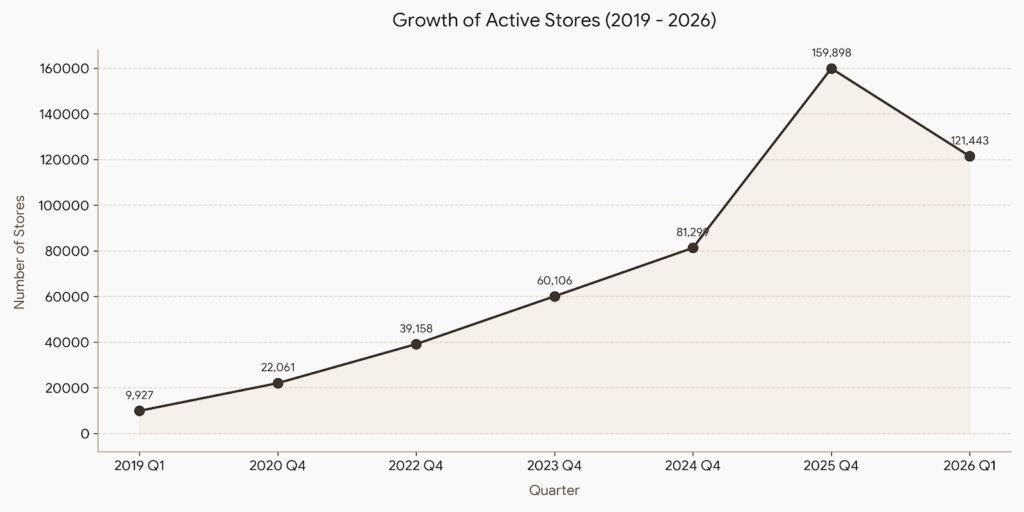
The Q1 2026 dip from the 2025 peak reflects seasonal attrition and platform consolidation — a pattern seen globally after high-growth years. The underlying trend remains intact: 32% year-over-year growth as of Q1 2026.
India is also the second-largest source of traffic to Shopify.com globally, contributing 16.98 million visits per month — behind only the United States. The platform appetite is clearly there. The commercial infrastructure is rapidly catching up.
This growth is not driven by casual side projects. India’s Shopify ecosystem is increasingly built around serious direct-to-consumer (D2C) brands — funded, scaling, and reaching customers through a mix of branded websites, social commerce, and quick commerce channels. Shopify has become the backbone of India’s D2C movement.
Which Industries Are Growing Fastest
| Industry | Share of Indian Shopify Stores | Momentum |
| Apparel & Fashion | 38.7% | Dominant |
| Home & Garden | 13.0% | Steady |
| Beauty & Fitness | 11.3% | High growth |
| Health & Wellness | ~8% | Fastest growing |
| Food & Beverage | ~5% | Emerging |
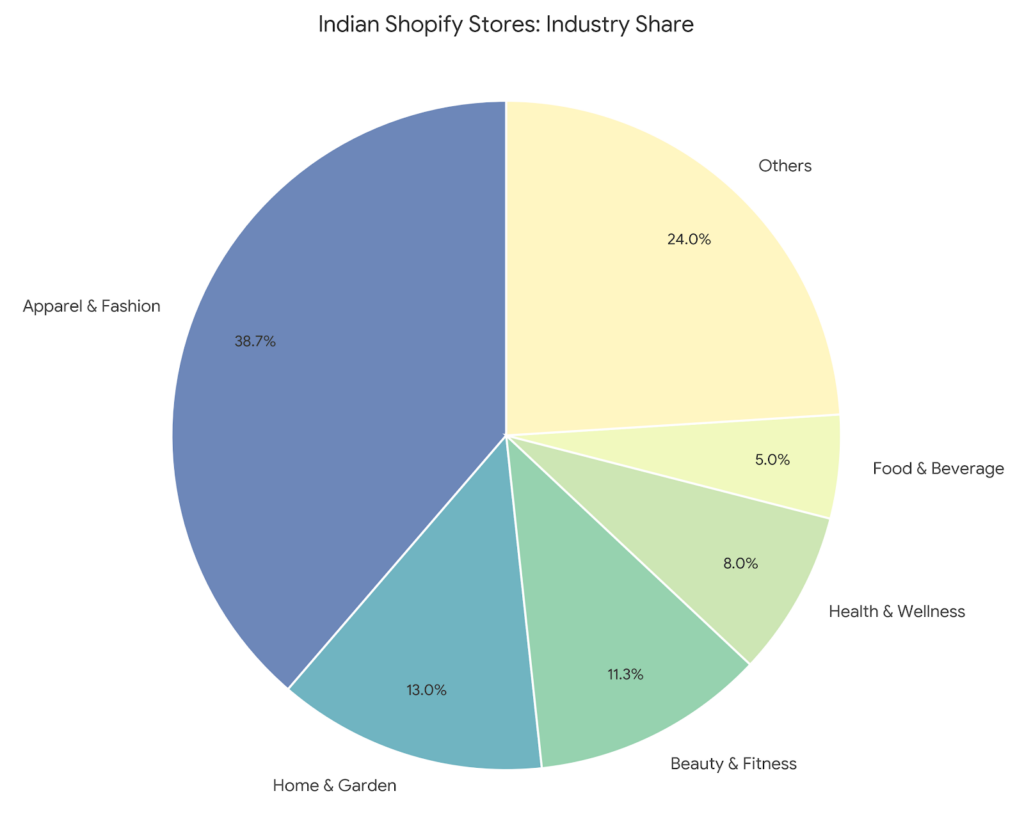
Apparel is the largest category by volume, but Beauty and Health are the most dynamic. The rise of brands like Minimalist, Plum, Bombay Shaving Company, and Dr. Vaidya’s has demonstrated that Indian consumers are willing to pay a premium for story-driven skincare, grooming, and wellness products — and they are buying direct. India currently has over 80 active D2C brands in beauty and personal care alone, most running Shopify as their primary commerce infrastructure.
Emerge Digital view: Health and wellness is where India’s next wave of Shopify success stories will emerge. Consumers are actively researching Ayurvedic supplements, functional foods, and clinical skincare online — and converting at strong rates. The upside is enormous for well-positioned brands that invest in the right store experience.

Shopify vs Marketplaces: Why Indian D2C Brands Are Choosing Both
For most Indian D2C founders, the Shopify vs marketplace question is not either/or. It is sequencing.
Phase 1 — Marketplace validation (₹0 to ₹5L/month) Brands launch on Amazon or Flipkart to validate product-market fit with existing traffic. Low risk, low margin, no brand control.
Phase 2 — Shopify alongside marketplaces (₹5L to ₹30L/month) A Shopify store launches alongside the marketplace presence — primarily to begin building a direct customer relationship, capture email and WhatsApp data, and improve margin by removing the commission layer.
Phase 3 — Shopify as primary, marketplaces as acquisition (₹30L+/month) The Shopify store becomes the primary revenue engine and brand home. Marketplaces shift to a top-of-funnel discovery role, feeding the owned ecosystem rather than owning the customer.
The margin difference makes this migration economically inevitable for most brands. Marketplace commissions in India typically run 15–35% depending on category. A brand doing ₹1 crore/month on Amazon at 25% commission is paying ₹25 lakh/month in fees — enough to fund a well-built Shopify store, a performance marketing team, and a retention programme, with room to spare.
The brands that make this transition successfully are the ones that build their Shopify store to be a genuinely better buying experience than the marketplace — faster, more trusted, more personal. Not just a website that exists.
Where the Stores Are: India’s Shopify Geography
Shopify adoption closely mirrors India’s startup geography. Maharashtra, Delhi, and Gujarat lead by store count, together accounting for nearly 40% of all Indian Shopify stores.
| City | Shopify Stores |
| Mumbai | 9,706 |
| New Delhi | 8,060 |
| Bengaluru | 7,568 |
| Hyderabad | ~3,200 |
| Ahmedabad | ~3,100 |
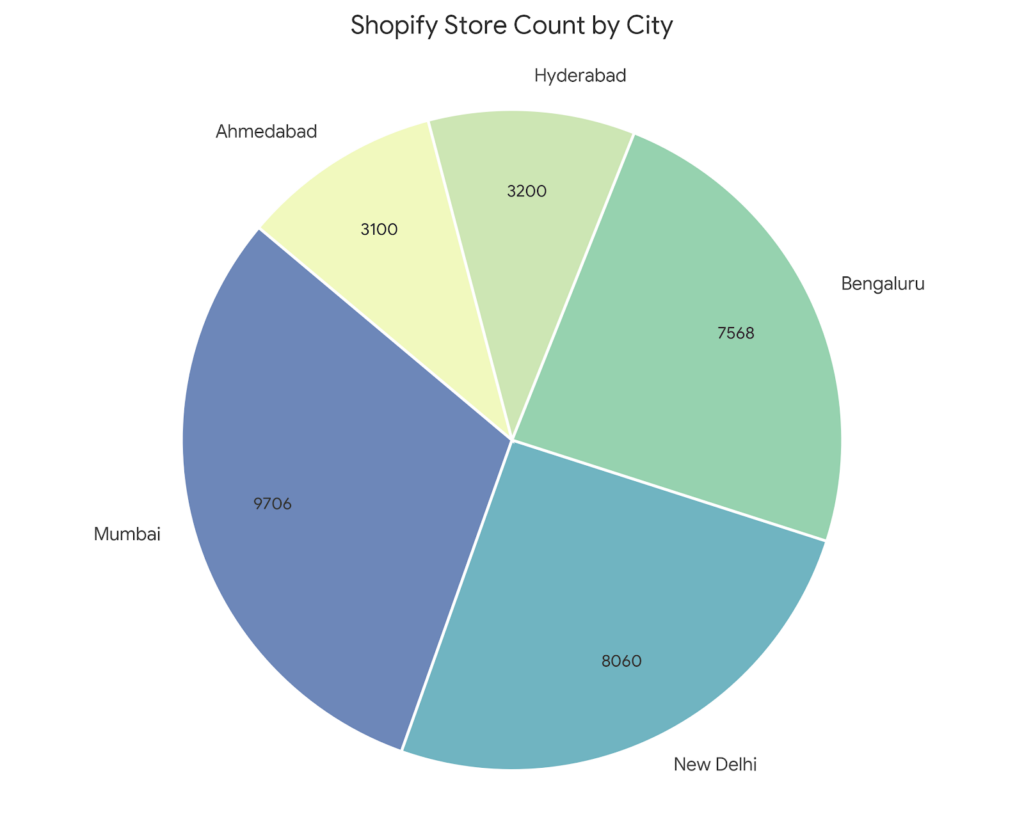
Bengaluru punches well above its weight relative to population. The city’s dense ecosystem of founders, performance marketers, and designers has made it the operational hub for many of India’s most sophisticated D2C brands — even when the brand is headquartered elsewhere.
Conversion Rates: Where Indian Stores Leave Money on the Table
This is where the biggest opportunity lies — and where the average Indian Shopify store is currently underperforming.
Analysis of 100+ Indian Shopify D2C stores (2025–26) shows:
| Device | Conversion Rate | Context |
| Mobile | 1.2% | 78% of India D2C traffic arrives on mobile |
| Desktop | 3.1% | 2.6× higher than mobile |
| Overall average | 1.8% | Benchmark across 100+ Indian stores |
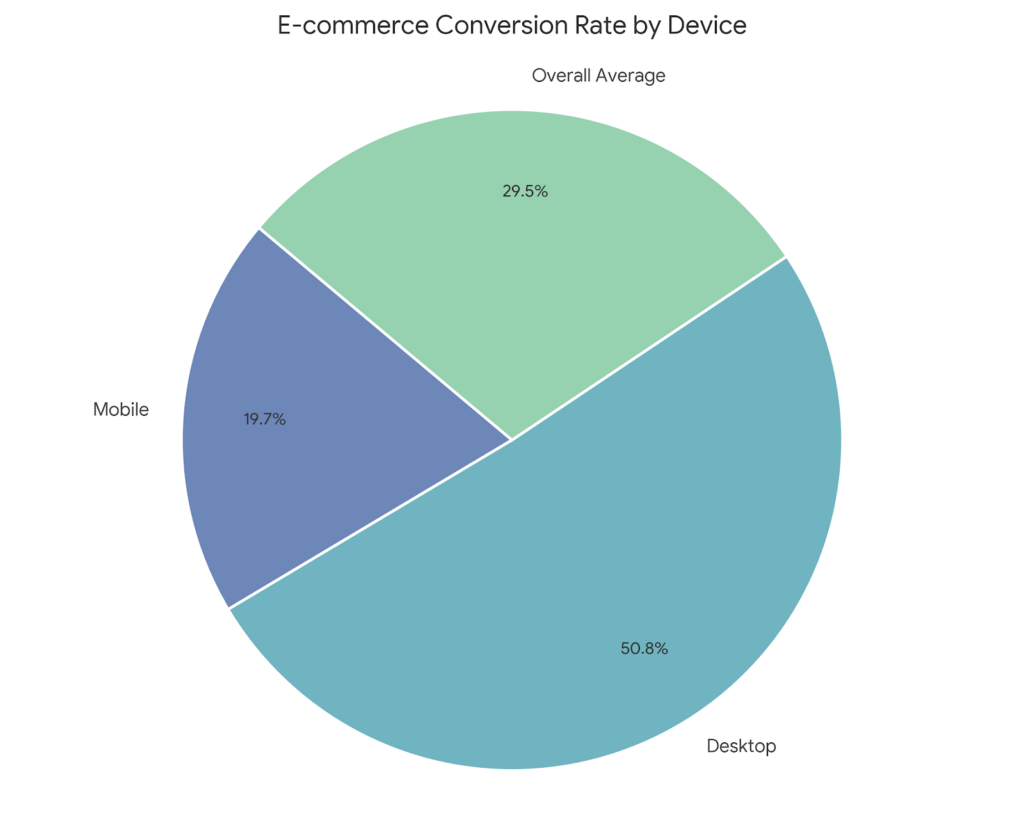
The global Shopify average for established stores sits at 2.5–3.0%. Indian stores are converting below that — not because of product or pricing problems, but because of three structural issues:
- Payment method friction Indian shoppers convert 34% more when UPI is the primary payment option. Yet many Shopify stores still do not lead with UPI at checkout. Meanwhile, Cash on Delivery (COD) accounts for 42% of India D2C orders — but carries a 24–38% return-to-origin (RTO) rate, quietly destroying margins on the back end.
- Trust signals 68% of Indian online shoppers cite trust signals — reviews, certifications, clear return policies — as the primary factor influencing their purchase decision, ranking above price. Stores that invest in social proof infrastructure consistently see measurable conversion lifts.
- Product content quality 71% of shoppers returned a purchase in 2024 because product content was incomplete or misleading. Poor images, missing specifications, and vague descriptions are conversion killers that are fully within a merchant’s control to fix.
Fix mobile checkout. Lead with UPI. Build trust signals. These three changes alone would close most of the conversion gap between the average Indian Shopify store and a top-quartile one.
Shopify Plus in India: Enterprise Commerce Has Arrived
Shopify Plus is the enterprise tier — built for high-volume merchants requiring advanced customisation, dedicated support, and multi-channel capabilities. As of Q1 2026, India has 988 active Shopify Plus stores.
| Market | Shopify Plus Penetration |
| India | ~0.8% |
| Global average | ~1.7% |
| US share of global Plus base | ~55% |
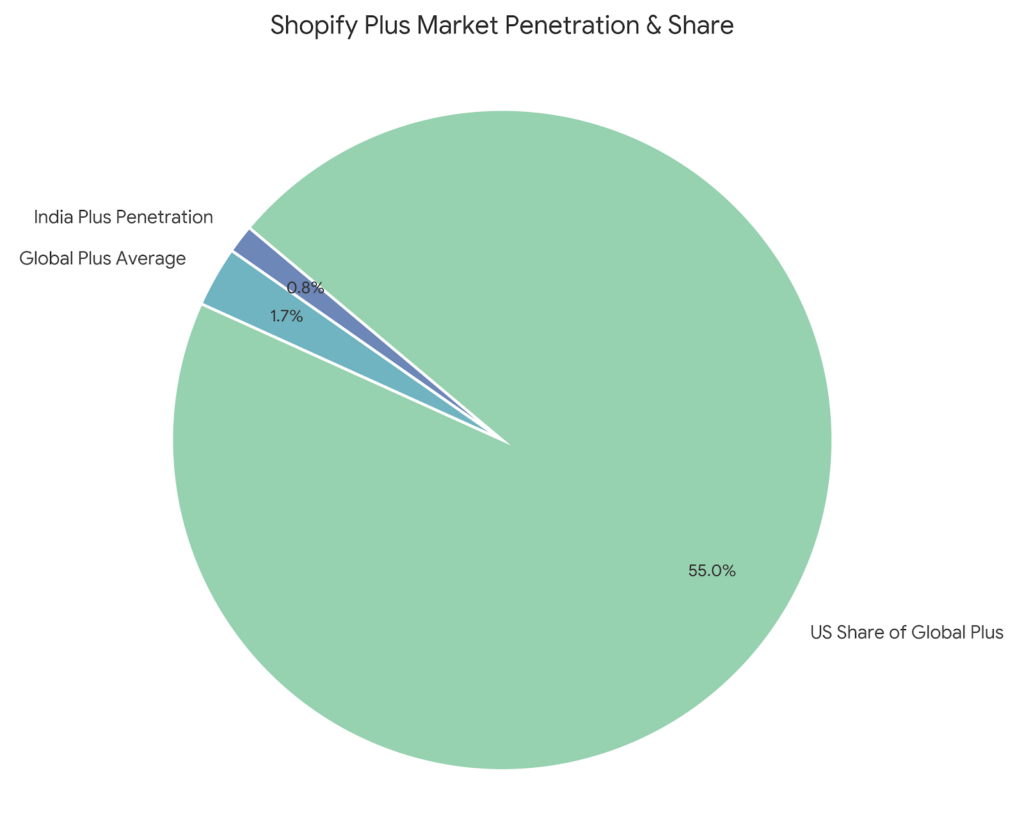
India’s 0.8% Plus penetration rate trails the global average — but this reflects where the ecosystem currently sits: in the scaling phase, not yet at enterprise entrenchment.
The brands moving to Plus are typically those crossing the ₹50–100 crore annual online revenue mark, where standard Shopify’s limitations around checkout customisation and multi-store management begin to matter. India’s funded D2C cohort — brands like Mamaearth, boAt, Bewakoof, and The Whole Truth — are precisely the type of operator Plus was built for.
If your Shopify store is generating ₹3–5 crore or more in annual online revenue and you are not on Plus, you are likely leaving checkout conversion, automation, and multi-channel capabilities on the table.
Plus adoption in India will accelerate significantly over 2025–2027 as more brands cross the revenue thresholds that justify the investment — and as Shopify continues localising features for the Indian market.
What Comes Next: Three Forces Shaping India’s Shopify Ecosystem
The next phase of India’s Shopify story will not be about store count. It will be about store quality. The brands that invest in the right infrastructure now will compound their advantage as the market matures and acquisition costs rise.
Three forces will define that next phase.
- Social commerce integration
39% of Indian shoppers made purchases based on influencer recommendations in 2024 — up 18% year-over-year (Be Pragma D2C Report, 2025). But most Indian Shopify stores are still treating Instagram and WhatsApp as traffic sources rather than commerce channels. The gap between a brand’s social presence and its Shopify checkout experience is where conversions are lost.
The brands that win the next three years will be the ones that make the journey from a WhatsApp message or an Instagram reel to a completed checkout feel seamless — not like switching between two different worlds. Shopify’s native WhatsApp integration and social channel APIs make this more achievable than it has ever been. Most brands just haven’t built it yet.
- Headless and composable commerce
Larger Indian brands are beginning to explore Shopify’s Hydrogen storefront framework, which allows front-end customisation far beyond what themes permit. This matters for one reason more than any other: performance on 4G networks.
Sub-2-second load times are achievable on headless Shopify builds in ways they simply aren’t on standard theme-based stores carrying 20+ apps. For brands spending ₹20–50 lakh per month on paid traffic, the conversion uplift from a 1-second improvement in mobile load time can justify the infrastructure investment within a quarter.
This is not a conversation about technology. It is a conversation about unit economics.
- Shopify’s own India focus
The platform has steadily localised for India — Razorpay and PayU integration, UPI-first checkout support, WhatsApp commerce capabilities, and ongoing improvements to cross-border logistics tools. India’s second-place position in global Shopify.com traffic signals that the company sees this market as a strategic priority, not a regional afterthought.
As Shopify continues building India-specific features — and as Indian brands continue growing into the revenue tiers where those features matter — the platform will become an even stronger foundation for D2C growth than it already is.
Final Word
The 121,000+ stores active in India today represent early adoption. The total addressable base of Indian brands with the intent and scale to run a Shopify storefront is likely ten times that. The growth curve is steep, and it is far from done.
But here is what the store count data doesn’t tell you: most of those 121,000 stores are underperforming relative to their potential. The average Indian D2C store converts 1.8% of visitors. The global benchmark for established stores is 2.5–3.0%. That gap exists not because Indian consumers are harder to convert — it exists because most stores were built to launch, not to scale.
The brands that close that gap will not do it by spending more on ads. They will do it by building better infrastructure — faster stores, smarter checkout flows, stronger mobile UX, and product pages that are built around how Indian customers actually make purchase decisions.
At Emerge Digital, that is the work we do. We are a Shopify agency in India that works with D2C brands at every stage — from founding teams launching their first store to scaling brands rebuilding for performance and operators moving to Shopify Plus. We have worked across apparel, beauty, wellness, food, and lifestyle categories, and we understand both the technical side of Shopify and the commercial realities of growing a D2C brand in India.
If you want to understand where your store sits relative to these benchmarks — or if you already know it’s underperforming and want a clear plan to fix it — we’re happy to take a look. No templates, no generic audits. Just a direct conversation about what’s holding your store back and what it would take to close the gap.

Get Started With Emerge Digital
Looking to build or scale your Shopify store?
Get in touch with our team to discuss your project and explore how we can help you grow your ecommerce business

Explore more
Ecommerce Solutions for Perfume & Fragrance Brands: Why Agencies Deliver Luxury Experiences
Ecommerce Development for Skincare & Beauty Brands: How Agencies Create Scalable Solutions
E-commerce Development for Jewellery Brands: Building Trust for High-Value Purchases

About the Author
Priya, Co-Founder of Emerge Digital, is a UI/UX enthusiast with 15 years of experience. She’s passionate about crafting user-centered designs that exceed expectations, delivering meaningful and engaging digital experiences. At Emerge Digital, Priya blends her deep expertise with a commitment to client and user needs, driving innovative design solutions.